
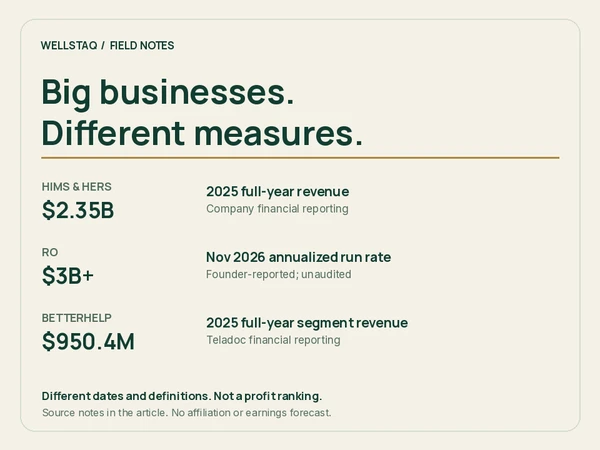
Hims & Hers, Ro and BetterHelp show that a recognizable health brand can support a large recurring business. They also show why revenue alone is a poor launch plan. Your useful question is smaller: can one offer deliver continuing value to your audience, with clear clinical responsibilities and enough contribution to cover its real costs?
The opportunity is a customer relationship worth keeping
You can sell your audience another launch. Or you can explore a service they have a reason to keep using. The second option deserves a serious operating plan.
The three businesses below are useful case studies because their public disclosures show both scale and tradeoffs. They are not interchangeable business models, Wellstaq customers or evidence of what a new brand will earn. Wellstaq publishes this analysis and sells white-label infrastructure; we have a commercial interest in the topic and no affiliation with these companies.
Use this guide to separate three decisions: what your audience values repeatedly, who can deliver each part, and which receipts actually belong to your business. If you are still mapping the service layers, start with our guide to planning a Hims-style brand.
Read the numbers without confusing revenue, run rate and profit
| Business | Verified measure | What it does not establish |
|---|---|---|
| Hims & Hers | Approximately $2.35 billion revenue for full-year 2025 | Revenue is not profit or a new brand’s attainable result. |
| Ro | Founder-reported $3B+ annualized run rate in November 2026 | A recent-period annualization is not audited full-year revenue. |
| BetterHelp segment | $950.4 million revenue for full-year 2025 | A segment is not a standalone company valuation or cash distribution. |
These figures have different dates and definitions. They should not be combined into a ranking. Sources: Hims’ full-year shareholder letter, Ro’s founder account and Teladoc’s 2025 annual filing.
Market size is broader still. Grand View Research projects a $150.13 billion U.S. telehealth market by 2030. That estimate covers a broad mix of services, software and hardware. It is category context, not the addressable market for your specific membership.
Hims & Hers: scale the relationship, watch the margin
Hims & Hers’ 2025 shareholder letter reports about $2.35 billion in annual revenue and $128.4 million in net income. Those are distinct measures.
The November 9, 2026 quarterly release reports $890.4 million in Q3 revenue and nearly 2.8 million subscribers at September 30. It also reports gross margin of 57%, versus 74% a year earlier, and reduced full-year adjusted EBITDA guidance. More revenue did not remove pressure on the economics.
The founder’s decision: define the repeat customer experience before designing a subscription. Specify what customers receive, what support is available and what renews. Then review delivery cost and retained contribution alongside growth. A familiar-looking storefront does not reproduce an established company’s clinical operations, fulfillment capabilities or results.
Ro: focus can matter more than the size of the menu
In his November 11, 2026 account of rebuilding Ro, co-founder Zachariah Reitano describes a $3B+ run rate and nearly tenfold business growth since the 2022 refounding. He defines the annualized measure as November revenue multiplied by twelve. Treat it as a company-reported, unaudited measure, not completed annual revenue.
His account describes consolidating brands, stopping initiatives with unfavorable economics and concentrating execution, including on Ro Body. This supports a lesson about focus; it does not prove that selecting a popular treatment guarantees growth.
The founder’s decision: choose one initial customer problem and one supported journey your team can explain and operate. Document the boundaries before adding categories. A long menu creates more ways to disappoint people when availability, pricing or support is unclear.
BetterHelp: attention has a substantial cost
Teladoc’s 2025 Form 10-K reports BetterHelp segment revenue of $950.4 million, down 9% from 2024. Advertising and marketing expense was $518.5 million, excluding stock-based compensation. Dividing those disclosed amounts gives approximately 54.6% of segment revenue. That is our calculation, not a customer acquisition cost or a benchmark your brand should copy.
BetterHelp is primarily a virtual therapy business. It should not be presented as the same prescription-fulfillment model as Hims or Ro. The relevant comparison here is the relationship between recurring services, demand and marketing expense.
The founder’s decision: record what it costs to acquire and retain a paying customer. Include content production, staff time, partner compensation, paid media and support. A social following is a distribution advantage to test, not proof of free acquisition or purchase intent.
Turn attention into a testable offer
Start with the question your customers keep asking after their first purchase. A creator, health brand or clinic with an audience can investigate that need before paying to build a broad service.
- Choose the audience: a specific group you already understand and can reach with permission.
- State the recurring value: what remains useful in month two, even when no new test or prescription is appropriate?
- Map service owners: brand support, platform, independent clinician, laboratory and pharmacy where applicable.
- Test the complete economics: use actual quotes and conservative demand assumptions.
Independent licensed clinicians decide care and prescribing. Laboratories perform testing; pharmacies dispense. A consultation never guarantees a prescription. Do not create unnecessary testing or medication continuation to sustain a membership.
Use the clinical responsibilities guide to assign owners, then the launch readiness checklist to identify unresolved scope.
A contribution worksheet you can actually use
Separate revenue your brand recognizes from payments that belong to clinical or pharmacy providers. The worksheet below starts with your own nonclinical membership receipts. Your actual arrangements determine what belongs in each line.
Monthly contribution = active paying members × (membership revenue per member − variable delivery cost per member) − acquisition spending − fixed operating costs.
Here is a deliberately invented arithmetic example, not a Wellstaq customer, quote or earnings forecast: 40 members paying $50 for a separately scoped nonclinical service produce $2,000 in monthly receipts. At $20 of variable service/support cost per member, $400 of acquisition spending and $800 of fixed costs, the modeled remainder is $0. With 25 members and those same assumptions, it is −$450. Taxes, financing and any omitted expenses still need to be considered.
The lesson is operational: a modest demand shortfall can erase the apparent upside. Replace every assumption with evidence before making a decision. If you subsidize testing or care, include the quoted cost; do not treat it as free. Our membership pricing worksheet and operating-cost guide cover the next layer.
Where Wellstaq fits—and what you still own
Wellstaq connects white-label blood lab testing and 503A telehealth under your brand. Your health brand. Built for recurring revenue.
The platform supports a branded experience; your team still needs an audience, a specific offer, marketing and dependable nonclinical support. Confirm programs, locations, integrations and service ownership before launch. Independent licensed clinicians determine care and prescribing, laboratories perform tests and pharmacies dispense. Compounded drugs are not FDA-approved; a consultation does not guarantee a prescription.
As checked November 12, 2026, Wellstaq’s founding platform offer is $497/month for one brand, limited to the first 100 paid founding members, with lifetime rate protection under the applicable agreement. The planned regular platform price is $3,000/month. Service charges and optional builds are additional. Confirm final billing, eligibility and cancellation terms before paying.
Enrollment is planned to open December 7, 2026 at 8:30 PM ET / 5:30 PM PT. Today’s waitlist is free: no payment today, and joining does not reserve a founding place. A business-fit call also does not reserve access or activate services.
Bring a one-page plan to the call
A useful starting point is an existing audience, a recurring need you can describe and a team prepared to support the experience. If those pieces are missing, validate them before committing to a build.
Bring three things: your audience and current offer, the first service journey you want to explore, and your draft costs and responsibilities worksheet. We can discuss fit, supported scope and the questions you need answered before launch.
Book a Call to explore your brand’s fit. This is a business conversation, not a medical consultation. If you only want launch updates, join the free waitlist. No payment today; joining does not reserve a founding place.
Your first-offer worksheet: fill in evidence, not wishful numbers
| Decision or input | Your working answer | Evidence to obtain |
|---|---|---|
| Audience and recurring need | Who is it for, and what stays useful in month two? | Customer conversations and a concrete offer hypothesis |
| Recognized membership revenue | Your price × expected active paying members | Billing structure, terms, realistic demand and cancellations |
| Variable cost per member | Support + delivery + processing + any service subsidy | Written quotes; staff time; exception/refund allowance |
| Acquisition spending | Content + labor + ads + partners | A bounded test with actual spend and paying-customer denominator |
| Fixed costs | Platform + software + staffing + other overhead | Current agreements; separate one-time setup/build costs |
| Contribution and downside | Receipts minus all listed costs; repeat at lower demand | A reconciliation that separates provider money from brand revenue |
| Clinical and operating readiness | Named owners; supported programs and locations | Confirmed responsibilities, availability and tested handoffs |
Your next steps
- Choose one audience and one supported offer before expanding the menu.
- Replace worksheet assumptions with quotes and measured demand; test lower retention and volume.
- Name the brand, platform, clinical, laboratory and pharmacy owners; confirm costs and availability.
- Bring the completed brief to a business-fit call; do not equate a call or waitlist signup with enrollment.
Common questions
Do these companies’ results predict what my health brand can earn?
No. They are third-party examples with different scale, funding, dates and business models. Your results depend on demand, service delivery, costs and retention. None of the figures is a Wellstaq customer result.
Is an annualized run rate the same as annual revenue?
No. A run rate projects a recent period over a year. Ro’s founder describes multiplying November revenue by twelve. That is different from revenue earned over a completed financial year.
Does an existing audience make acquisition free?
No. It can help you reach people, but content, staff, partnerships, support and conversion still have costs. Followers are not automatically eligible or willing to buy.
Can I use a prescription as the guaranteed recurring benefit?
No. Independent clinicians decide whether treatment is appropriate and whether it should continue. A consultation never guarantees a prescription, and clinical decisions must not follow a subscription sales target.
What is the next step with Wellstaq?
Book a business-fit call with your audience, first-offer idea and worksheet. The platform is waitlist-only before founding enrollment opens; a call or free waitlist signup does not reserve a founding place.
Sources & context
The frameworks, worksheets and operating examples are WellStaq’s planning guidance. Primary sources support the specific regulatory context; they do not endorse WellStaq or approve an individual business.
Sources checked November 12, 2026. Prepared with AI assistance; no independent clinical or legal review is claimed. Business education, not individualized medical, legal or financial advice. Editorial standards.